
Thursday, September 27, 2012
ART & COPY Trailer
# posted by Unknown : Thursday, September 27, 2012

Tuesday, September 25, 2012
Egypt has shown a fast disposition toward mobile phone usage
Egypt has shown a fast disposition toward mobile phone usage—the International Telecommunication Union estimates that there were 83.4 million mobile phone connections in 2011 among a total population of about 82.1 million. But smartphones have made slower progress in penetrating the population. A January–March 2012 survey of individuals in Egypt commissioned by Google as part of their “Our Mobile Planet” study, conducted by third-party research firms, found the smartphone adoption rate to be only about 26%.But those who do have smartphones and other internet-enabled mobile devices have taken quickly to using both the mobile internet and apps, according to an April poll in Egypt conducted by mobile advertising network Plus7. The survey found that more than six in 10 respondents accessed a mobile website or used an app several times a day, while about one in 10 did so at least once a week.Read more at http://www.emarketer.com/Article.aspx?R=1009349#g4clA1Qiq56aLQQE.99
# posted by Unknown : Tuesday, September 25, 2012
Friday, August 03, 2012
How Syria's video activists use camera phones to fight the revolution - video
How Syria's video activists use camera phones to fight the revolution - video
Ahmad Mohammad is a Syrian video activist. He uploads smartphone footage of demonstrations, gun battles and casualties to the internet in an attempt to chronicle the crimes of Bashar al-Assad regime and show the world what is happening in Syria. YouTube and Facebook are banned in Syria, but Mohammad uses proxies to gain access to them
# posted by Unknown : Friday, August 03, 2012
Sunday, January 29, 2012
Emirati slang revived with iPhone app Amna Al Haddad
Emirati slang revived with iPhone app
Jan 29, 2012

DUBAI //Older Emiratis will tell you a barkhees is unlikely to buy you so much as an aranjous.
That will not mean much to many young Emiratis, as barkhees (miser) and aranjous (orange juice) are old slang terms unique to the Arabic spoken in the UAE.
Realising many such words could soon be lost if not recorded, Faisal Jassim and Thani Al Shafar, both 25, have launched a virtual dictionary of Emirati terminology in Arabic and English.
Their iPhone application Thikrayat (at www.appthik.co) collates these words for posterity and often pairs them with illustrations.
The name of the application is an old word meaning things remembered from the past.
"We started by accident," said Mr Al Shafar.
"We were getting to know words through the elderly in the family that we had never heard of before. We realised that we no longer used such words, so we started collecting them."
Mr Jassim said this disconnect between generations was "a tragedy, because these words give flavour to the Emirati dialect".
So far, 100 words have been included and 300 more with illustrations are to be released soon. Among the words that were fading from the language are nomlait, for lemonade; dahdeeha, meaning quick; and pankah, for ceiling fan.
"Our society has been established based on an oral history and our ancestors didn't read and write," Mr Jassim said. "When they pass away, their history and memories will be gone as well.
"If we don't preserve them now, they'll be lost. These words are what gives us a flavour. It's like our saffron, our spices."
Mr Al Shafar said the app was also aimed at engaging expatriates.
"The application can be accessed globally and foreigners can download it before coming to the UAE, and know the language and learn about the UAE culture," he said.
The two also accept feedback and suggestions from the public.
"We want the application to become a community project," said Mr Jassim.
# posted by Unknown : Sunday, January 29, 2012
Saturday, December 31, 2011
Saudi government considers banning smartphones for public employees
The Saudi government is considering banning all public employees from using smartphones and tablets, such as iPhones, iPads, and BlackBerry devices, during working hours after receiving complaints from the public, Saudi Gazette has reported. The directors general of three ministries have sent letters to their superiors requesting that they "look into the matter," the daily said, citing a source at the Department of Civil Status. Currently, there are no restrictions on public employees using smartphones and tablets.
# posted by Unknown : Saturday, December 31, 2011
Thursday, November 03, 2011
Mobile phone penetration rates in the UAE are the highest in the Arab world, according to the latest report by the Arab Advisors Group.
As at the end of September 2009, the rate for mobile phone users in the UAE stood at 193.5 percent, followed by Saudi Arabia with a rate of 165.5 percent.
The report, which covered 47 mobile operators in 17 Arab countries, also showed that there was a total of 241.3 million cellular subscribers by the end of Q3 2009.
This represented a 16.6 percent growth compared to the 206.9 million subscribers recorded at year-end 2008.
According to the Arab Advisors Group report, MobiNil (Egypt), Vodafone Egypt (Egypt) and STC (Saudi Arabia) were the largest operators in terms of subscriber bases.
MobiNil and Vodafone Egypt boasted 23.4 million and 22.1 million subscribers respectively while STC ended the first nine months of 2009 with 20 million subscribers.
Three new cellular operators launched in the region during the period covered by the report - Zain in Saudi Arabia, Viva (STC) in Kuwait, Vodafone in Qatar.
# posted by Unknown : Thursday, November 03, 2011
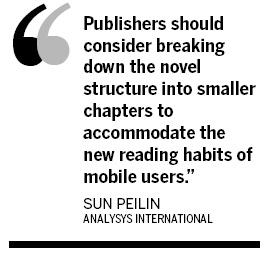
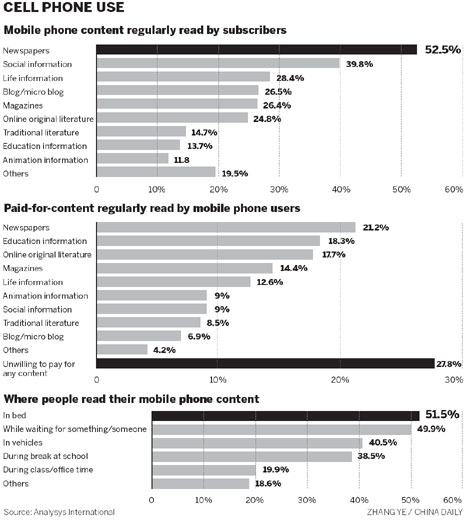
Smartphones change our habits in China
Smartphones change our habits in China
Updated : 2011- 11- 01 07:34
By Wei Tian (China Daily )
| |||||||||


 |
# posted by Unknown : Thursday, November 03, 2011
Monday, August 22, 2011
From SMS to Smartphones: Tracing the Impact and Developmental Trajectory of the Mobile Phone in Asia
From SMS to Smartphones:
Tracing the Impact and Developmental Trajectory of the Mobile Phone in Asia
13-14 February 2012, National University of Singapore
Asia is widely regarded as a region that has enthusiastically embraced information technology. This observation is especially true of the region's adoption and appropriation of the mobile phone. The affordability, versatility and ubiquity of the mobile phone has had a discernible impact on Asia. Despite the significance of mobile phones in the Asian landscape, research on this topic has been shaped by studies on the US and Scandinavia, while research on Asia is growing, but in its nascent stages. This workshop seeks to address the imbalance by bringing together researchers who are studying mobile phone trends in Asia and collectively, workshop participants will discuss and deliberate over the global implications of their research findings and the developmental trajectory of the mobile phone. The workshop will be held at the Department of Communications and New Media, National University of Singapore from 13-14 February 2012.
The workshop aims to be multi-disciplinary, comprising up to fifteen speakers who will have the opportunity for sustained discussion and engagement over two days. Based on the quality of proposals and the availability of funds, partial or full funding is available for successful applicants. Full funding would cover air travel to Singapore by the most economical means, plus board and lodging for the duration of the workshop. Priority for funding will be accorded to applicants who are based in Asia. We invite those interested in participating in the workshop to submit original paper proposals which should include a title, an abstract of 500 words, a short biography of 250 words by 15 September 2011. Papers that have been selected will be notified by 30 September 2011. If accepted, the full paper must be submitted by 30 November 2011. Selected papers will be developed and included in a special journal issue or edited volume. Please see the workshop website<http://blog.nus.edu.s
g/cnmblog/2011/08/16/call-
Set within the Asian context, the workshop seeks to address questions including, but not limited to the following:
*
does a digital divide exist in Asia with regard to mobile phone penetration and usage trends and if so, how can and should they be remedied?
* what are the implications of the development of mobiles - especially smartphones and mobile Internet - for contemporary media in Asia?
* how is the growing proliferation of the smartphone facilitating unprecedented forms and scales of communication?
* how are the location based services offered by smartphones altering user behaviour?
* how does mobile Internet use complement and possibly complicate fixed location Internet use?
* what implications does the growth of smartphone apps have for the cultural complexion of Asian countries?
* to what extent do smartphones and the behaviour which they enable test the boundaries of existing regulatory frameworks?
* how does the rising ubiquity of the smartphone and by implication, that of always-on, always-available Internet access challenge prevailing theoretical frameworks relating to inter alia, technology acceptance, mobility, communication, social influence and identity?
Workshop Convenors
Associate Professor Sun Sun LIM (sunlim@nus.edu.sgsunl
Department of Communications and New Media, National University of Singapore
Prof Gerard GOGGIN (ggoggin@usyd.edu.augg
Department of Communications, University of Sydney
Tracing the Impact and Developmental Trajectory of the Mobile Phone in Asia
13-14 February 2012, National University of Singapore
Asia is widely regarded as a region that has enthusiastically embraced information technology. This observation is especially true of the region's adoption and appropriation of the mobile phone. The affordability, versatility and ubiquity of the mobile phone has had a discernible impact on Asia. Despite the significance of mobile phones in the Asian landscape, research on this topic has been shaped by studies on the US and Scandinavia, while research on Asia is growing, but in its nascent stages. This workshop seeks to address the imbalance by bringing together researchers who are studying mobile phone trends in Asia and collectively, workshop participants will discuss and deliberate over the global implications of their research findings and the developmental trajectory of the mobile phone. The workshop will be held at the Department of Communications and New Media, National University of Singapore from 13-14 February 2012.
The workshop aims to be multi-disciplinary, comprising up to fifteen speakers who will have the opportunity for sustained discussion and engagement over two days. Based on the quality of proposals and the availability of funds, partial or full funding is available for successful applicants. Full funding would cover air travel to Singapore by the most economical means, plus board and lodging for the duration of the workshop. Priority for funding will be accorded to applicants who are based in Asia. We invite those interested in participating in the workshop to submit original paper proposals which should include a title, an abstract of 500 words, a short biography of 250 words by 15 September 2011. Papers that have been selected will be notified by 30 September 2011. If accepted, the full paper must be submitted by 30 November 2011. Selected papers will be developed and included in a special journal issue or edited volume. Please see the workshop website<http://blog.nus.edu.s
g/cnmblog/2011/08/16/call-
Set within the Asian context, the workshop seeks to address questions including, but not limited to the following:
*
does a digital divide exist in Asia with regard to mobile phone penetration and usage trends and if so, how can and should they be remedied?
* what are the implications of the development of mobiles - especially smartphones and mobile Internet - for contemporary media in Asia?
* how is the growing proliferation of the smartphone facilitating unprecedented forms and scales of communication?
* how are the location based services offered by smartphones altering user behaviour?
* how does mobile Internet use complement and possibly complicate fixed location Internet use?
* what implications does the growth of smartphone apps have for the cultural complexion of Asian countries?
* to what extent do smartphones and the behaviour which they enable test the boundaries of existing regulatory frameworks?
* how does the rising ubiquity of the smartphone and by implication, that of always-on, always-available Internet access challenge prevailing theoretical frameworks relating to inter alia, technology acceptance, mobility, communication, social influence and identity?
Workshop Convenors
Associate Professor Sun Sun LIM (sunlim@nus.edu.sg
Department of Communications and New Media, National University of Singapore
Prof Gerard GOGGIN (ggoggin@usyd.edu.au
Department of Communications, University of Sydney
# posted by Unknown : Monday, August 22, 2011
